Master of Science (M.Sc) in Agricultural Economics
Online (e-Learning) Course Via James Lind Institute
Bridge the gap between economic theory and real-world agricultural challenges with a specialized M.Sc. designed for the modern economy. Gain the expertise to analyze international food systems and drive sustainable development in a resource-constrained world.
After scholarship you may pay
only €1550 for the full course
Deepen your understanding of how economic forces shape global food and agriculture systems. This online M.Sc (18 months, 90 ECTS) from JLI Switzerland explores agri-market dynamics, trade policy, agricultural finance, and development economics. Graduates work as senior agricultural economists, policy advisors, and research analysts with governments, UN agencies, and development banks.
Building on a solid economics foundation, the programme covers international economics, econometrics, economic growth theory, monetary economics, and contemporary challenges in food systems and rural economies. Students develop the analytical rigour to assess the impacts of trade agreements, subsidy regimes, climate change, and technology adoption on agricultural productivity and food security. The research dissertation component enables graduates to contribute original analysis to their field — a valuable asset for roles in research institutions and policy bodies. The fully self-paced online format is ideal for agronomy professionals, development workers, and economists looking to specialise without interrupting their careers.
Experience a modern, flexible approach to higher education designed for working professionals that combines academic rigor with the convenience of 100% online delivery.
Study at Your Own Pace
Recorded lectures
Interactive digital course content
Comprehensive reading materials
24/7 access to Learning Portal
Structured Assessment
Multiple-Choice Tests
Assignment submissions
No stressful "timed" final exams
Constructive feedback from faculty
Academic Support: While you study at your own pace, you are never alone. The institution's faculty and academic coordinators are available to assist you throughout your learning journey.
Eligibility
Academic Background:
A recognized bachelors degree in a related discipline (Business, Commerce, Economics, or Finance).
English Proficiency:
Applicants must be proficient in English language (reading, writing, and speaking).
See the Language Requirements section below for more details.
Not sure if your degree qualifies? Apply for an initial assessment and our admissions team will confirm your eligibility within 48 hours.
Document Requirements
Please ensure you have clear digital copies of the following documents ready for your application:
Passport Photo: Head and shoulders only.
Identity Proof: Valid passport or government-issued ID card.
Degree: Copy of bachelors degree or equivalent qualification.
Academic Transcripts: All relevant mark sheets or supporting transcripts.
CV / Resume: Optional, but recommended for professional programs.
Important Note
Documents must be in English or accompanied by a certified translation.
Language Requirements
This program is taught entirely in English. Applicants should be comfortable using English for academic communication, including reading, writing, and speaking.
ApplyMate Advantage
When applying through ApplyMate, no formal proof of English language proficiency (such as IELTS or TOEFL) is required.
* Individual institutions may conduct a brief internal interview if required.
Application Processing Fee
€ 199
✓ 100% RISK FREE
Pay-Later Policy: Only payable after your initial assessment and eligibility is confirmed.
Full Refund Guarantee: 100% refundable if not accepted OR if the scholarship is less than 25%.
This policy ensures your investment is protected. We only succeed when you receive a high-value offer.
About James Lind Institute
Swiss Quality Certified
Based in Geneva, James Lind Institute is a premier Swiss institution specializing in Public Health, Clinical Research, and Pharmaceutical Medicine. With a global community of over 5,000 alumni across 120 countries, JLI is a top choice for healthcare professionals seeking career excellence.
100% Online: Optimized for working professionals worldwide.
eduQua Certified: Official Swiss quality label for further education.
Graduation: Exclusive option to attend in-person ceremonies.
Zero Misc. Costs: Transparent pricing with no hidden enrollment fees.
Empowering the next generation of global health and pharmaceutical leaders.
Get More Information via Email
Enter your details below and we will send you more information about this course, including scholarships and application guidance. You will also instantly download the curriculum.
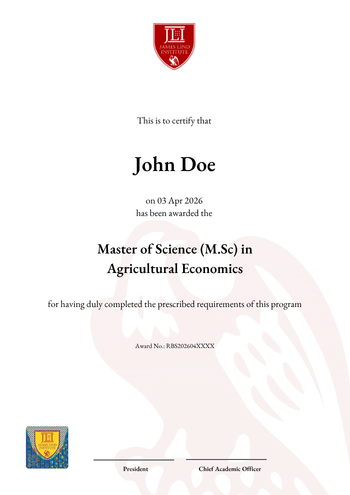
Sample Degree
Success Guarantee
Your success is our priority.
If we do not secure an offer of admission, or if the scholarship granted is less than 25%, ApplyMate will provide a 100% refund of your processing fee.
This ensures your investment in your future is completely protected.
Course Snapshot:
Institution
James Lind Institute
Study Mode
Online (e-Learning)
Location Online
Level
Masters
Duration1.5 Years
Credits 90
LanguageEnglish
What Our Students Say
★★★★★
4.9/5 average rating from recent learners
“
The program at James Lind Institute gave me a much deeper understanding of financial systems and risk assessment. The practical case studies were especially useful, as I could directly apply what I learned to my day-to-day work. It has significantly improved my analytical confidence and decision-making.
Daniel Mwangi
Credit Analyst
“
I found the course to be very relevant to the challenges we face in economic planning. The content was well-structured and easy to follow, even while managing a full-time job. It has strengthened my ability to interpret economic data and contribute more effectively to policy discussions.
Eva Bello
Financial Planning Officer
“
What stood out to me was the balance between theory and real-world application. The modules on global markets and financial strategy were particularly insightful. This program has helped me approach investment decisions with a more structured and informed perspective.
Thabo Mokoena
Investment Associate
“
The course provided me with valuable knowledge on financial inclusion and economic development. I now have a better understanding of how financial systems impact communities at a grassroots level. It has enhanced my ability to design and manage more effective financial programs.
Hint: The password should be at least eight characters long. To make it stronger, use upper and lower case letters, numbers, and symbols like ! " ? $ % ^ & ).